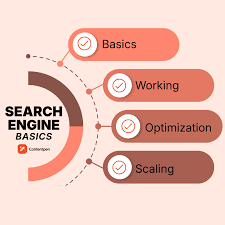

search engine basics Most people use search engines every day, but very few actually understand how they work. And that lack of understanding leads to weak SEO, poor content decisions, and wasted effort.
If you don’t understand search engine basics, you are basically guessing how online visibility works instead of controlling it.
This guide breaks it down in a simple, structured way so you can actually use it in SEO, blogging, or digital marketing.
What is a Search Engine?
A search engine is a system that helps users find information on the internet by scanning, organizing, and ranking web pages.
Example:
- You type: “best smartphones under 100k”
- Search engine returns: ranked list of relevant pages
But here’s the key truth:
It doesn’t “find answers”—it retrieves and ranks indexed documents.
Search Engine Basics: How It Actually Works
A search engine works in 3 core stages:
1. Crawling (Discovery Stage)
Search engines use automated bots (called crawlers or spiders) to scan websites.
They:
- Visit web pages
- Follow internal and external links
- Discover new or updated content
Example:
If your blog links to another page, crawlers follow that link automatically.
If your page is not linked anywhere → it may never be discovered.
2. Indexing (Storage Stage)
After crawling, search engines store and organize content in a massive database called the index.
Think of it like a giant library system.
They analyze:
- Page content
- Keywords
- Meta tags
- Images and alt text
- Page structure
If a page is not indexed, it cannot appear in search results—no matter how good it is.
3. Ranking (Result Ordering Stage)
When a user searches something, the search engine:
- Looks into the index
- Finds relevant pages
- Ranks them based on quality and relevance
Ranking is influenced by:
- Content quality
- Keyword relevance
- Backlinks
- User experience
- Page speed
- Mobile friendliness
Search Engine Basics: Simple Real Example
Let’s say you search:
“best SEO tools”
What happens behind the scenes:
- Search engine checks its index
- Finds thousands of pages about SEO tools
- Filters them based on relevance
- Ranks top pages (Ahrefs, Moz, etc.)
- Shows results in order of authority + usefulness
You only see the final output—but thousands of calculations happen instantly.
Key Components of a Search Engine
1. Crawlers (Bots)
They continuously scan the web.
Examples:
- Googlebot (Google)
- Bingbot (Microsoft Bing)
Without crawlers → no discovery.
2. Index
This is the stored version of the internet.
If your page is not in the index:
- It does not exist in search results
3. Algorithm
This is the ranking brain of a search engine.
It decides:
- Which page ranks #1
- Which page ranks #10
- Which page disappears completely
Algorithms constantly update, meaning rankings are never permanent.
Search Engine Basics for SEO Beginners
If you are doing SEO or content writing, these basics are not optional.
You must understand:
1. You don’t “rank keywords” — you rank pages
A single page can rank for hundreds of keywords.
2. Google rewards intent, not just keywords
Example:
Keyword: “buy running shoes”
Google prefers:
- Product pages
- E-commerce listings
Not informational blogs.
3. Content must match search intent
There are 3 main types:
- Informational (learn something)
- Navigational (find a site)
- Transactional (buy something)
Wrong intent = no ranking.
How Search Engines Decide What to Show First
Search engines evaluate pages using signals like:
1. Relevance
Does the page actually match the query?
2. Authority
Is the website trustworthy?
3. Content depth
Does it fully answer the question?
4. User experience
- Mobile friendly?
- Fast loading?
- Easy navigation?
5. Engagement signals
- Click-through rate
- Time spent on page
- Bounce rate
Common Misunderstandings About Search Engines
Mistake 1: “Google shows the best content”
Not always true. It shows the most optimized content.
Mistake 2: “More keywords = higher ranking”
Wrong. Overuse of keywords can hurt rankings.
Mistake 3: “Once ranked, always ranked”
False. Rankings change constantly.
Mistake 4: “SEO is only about backlinks”
Backlinks matter, but content relevance and structure matter equally.
Step-by-Step: How to Work With Search Engines (Not Against Them)
1: Create crawlable content
- Use proper headings (H1, H2, H3)
- Internal linking
- Clean URL structure
2: Ensure indexing
- Submit sitemap
- Use Search Console tools
- Avoid noindex mistakes
3: Optimize content for intent
- Match what users actually want
- Not what you want to say
4: Improve authority signals
- Build quality backlinks
- Publish consistent content
- Earn mentions from trusted sites
5: Improve user experience
- Fast website
- Mobile responsive design
- Clear structure
Why Understanding Search Engine Basics Matters
If you ignore these fundamentals:
- Your content will not rank consistently
- You will depend on luck, not strategy
- You will waste time creating content no one sees
If you understand them:
- You can predict rankings
- You can fix traffic drops
- You can scale SEO systematically
Final Insight
Search engines are not random systems—they are structured machines with rules.
Most beginners fail because they treat SEO like guessing.
Professionals win because they understand search engine basics and build content aligned with how discovery, indexing, and ranking actually work.