
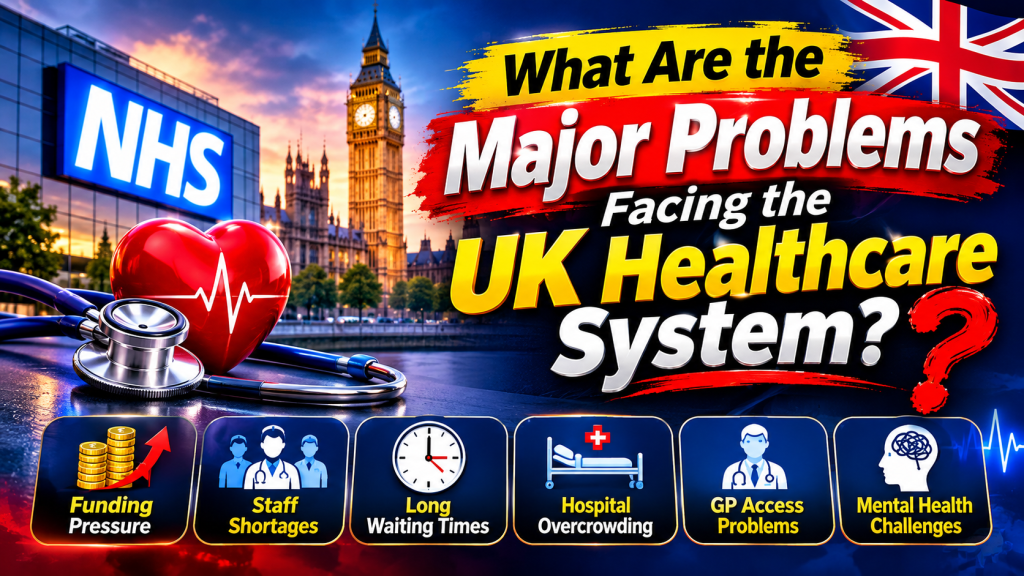

What Are the Major Problems Facing the UK Healthcare System?
The common issue for people living in UK is health issue, The biggest issue among these is UK healthcare funding pressure.UK healthcare system plays an important rule for the life of people, UK healthcare system helps people through international services like National healthcare system (NHS) which provides treatment, emergency help, health related things and essential items which are very important for human health.
Healthcare providers in the UK face a number of interconnected issues, some of which include severe shortages of funds, a lack of medical care and supplies, a lack of staff, and the inability to provide patients with timely medical care.
The UK healthcare system is one that doesn’t fail to deliver, with healthcare regulations varying significantly across England, Scotland, Wales, and Northern Ireland. The UK healthcare system needs significant planning to improve its services, investing money in healthcare across different sectors, and providing patients with the services they need at the right time.
1. Funding pressures and limited resources
A major challenge for the UK healthcare system is the UK healthcare funding pressure. The healthcare system must cover the costs of staff salaries, medicines, buildings, medical equipment, technology and treatments. This makes managing an expensive budget very difficult. Recently, in Parliament meetings, the issue of funding shortages, building and patient care costs has been discussed. When the system is short of funds, it also faces difficulties in purchasing medicines and other necessary things for treatment. For this reason, it is not only important that the money being invested in the UK healthcare funding crisis is sufficient, but it is also crucial that the money is being spent in the right places, whether it is being used to buy essential goods, and whether it is causing hardship for people. The UK healthcare system needs to sit down and plan and effectively address these issues, preventing disease and simultaneously bolstering local healthcare services and hospitals so that health issues can be effectively addressed. UK healthcare funding pressures can also make it very difficult to fund local healthcare services at the right time or in a timely manner, leaving people unable to access a good service.
2. Staff shortages and workforce pressure
In the UK, care workers are working less to manage health, however, one of the issues is that they are facing a lot of workload and there is a shortage of new staff and a lot of difficulties are faced in keeping the old staff on the job. A typical staff can only do 6 to 12 hours duty, if they work 24 hours then they will face a lot of difficulty and it will have a lot of impact on the health of the people as there is very little time for the patients to take care of the people. Training new staff takes a lot of time, which exacerbates existing staff shortages. The UK healthcare system must address not just existing staff but also future needs. Healthcare systems need good management, adequate staff, and better conditions if they are to progress. Relying on the old staff can make it very difficult to improve with new staff. A lack of staff can lead to a significant number of patient burdens. Experts in this area believe that retaining staff is as important as recruiting new staff.
The burden of reducing staff is very heavy which is related to the condition of the staff,if number of patients decreases in a day then the old staff is not able to handle that much work and it becomes difficult for the staff due to which the health of the staff can also be affected. To reduce the staff some breaks are required so that they can take some rest, just scheduling the appointment is not enough. If any expert staff loses his job then it affects the other staff as well and the entire team, because if there is a shortage of staff then it becomes very difficult to reduce the remaining staff. The UK healthcare system needs to take good care of its staff, providing them with everything they need on time and providing them with good facilities that they feel comfortable working in. If staff are sourced from other countries, that’s even better, and those living in the UK should be trained so they too can become capable and take charge of their own health.
3. Long waiting times for treatment
Patients have to wait for a doctor’s appointment, tests to diagnose the disease, and an operation that has already been fixed. Therefore, this problem can have a huge impact on the daily lives of patients. Last year in November 2025, the UK Parliament released a report criticizing NHS England for delays in treatment, due to which thousands of people are still waiting for treatment. This report was only for England and not for the entire UK. If a doctor is unable to treat a patient, then the patient should be referred as soon as possible to another doctor who is an expert in the disease.
4. Hospital overcrowding and emergency care
Whenever the number of patients reaches twelve, there is a huge rush in the emergency department and people need immediate treatment. It is not only this issue but also the issue of hospitals which face shortage of beds, shifting patients to operation rooms or wards. This has a huge impact on the health and daily life of the patients. And the ambulance drivers also face difficulty in shifting the patients to the hospital because there are already many people waiting in the emergency department. According to a recent report of the National Audit Office, shifting and discharging patients elsewhere puts pressure on emergency care. This is a problem that hospitals alone cannot address; community services can provide timely treatment for patients. UK healthcare funding pressures can make it difficult to provide services without extra support.
5. Access to GP and primary care services
Patients’ first priority is their GPs, but even then, patients may not be able to get timely appointments, especially in areas with high patient numbers. GP teams are often short of staff and handling difficult illnesses. When people’s pain becomes severe and their illnesses are not controlled, they often go to the emergency department to get their treatment done. Supporting GP clinics, retaining specialist staff, and providing suitable appointment options may prove beneficial. Digital services also help in some ways, like they should be available for those who do not know or cannot take online help.
6. Mental health services under pressure
Everyone needs mental health, whether they are male or female, young, young, or old. Mental health facilities in the UK are not the same everywhere. Waiting too long can further hamper a person’s mental health. Don’t think of this as a separate issue, because mental health is a vital part of a person’s healthcare. Schools, community organizations, GPs, or other teams can all help with this, while more urgent issues require a professional trainer. Improve your services and take care of the patients who have already told you their problem, you do not have to tell them again.
7. Unequal access to healthcare
There are also services that can impact access to treatment due to distance, such as income, housing, transportation, disability, language, and employment. There are also communities where diseases are more prevalent and difficulties are more severe. This is called health inequalities. Justice means treating everyone equally, giving more importance to the needs of local people. This means paying more attention to the needs of those who do not have decent housing or cannot afford clean food, so that their difficulties are reduced a little.
8. An ageing population and rising demand
In such cases, some patients are very old and elderly and also need help with their illnesses, including appointments, medication, and treatment to improve their health. Health and social care needs are interconnected. If such patients cannot meet their needs at home, they may end up in the hospital. Services that are well-planned for such needs are better suited to those who cannot meet their needs at home, and it is better to give them more attention. It is also important to take great care of the freedom and dignity of the mother.
9. What could improve the system?
The UK healthcare crisis isn’t a single issue that can be addressed; there are many that need to be addressed. Better funding, full support for staff, and investment in hospitals and medicines are all crucial. UK health funding pressures must ensure that money is invested in the right places, with thorough planning.
Conclusion
UK ke healthcare system ko paison ki kami, staff ki kami, sahuliyat ki kami, ilaaj ka saman na hona aur barhte hoe bemariyon ka masla hai. UK healthcare funding pressure ka masla bhe Ain maslo me se sab se bara masla hai. Behtri lane ke liye staff ke zarorat buhat hai aur mareezon ka khayal rakhna bhe ziyada acha hai aur paiso ka bhe investment karna bhe acha hai jis se behtri ho sakte hai. Sare healthcare services mil kar kam kare aur maslo ka hal nikale sahi planning se aur mil kar mushkil halat ka samna karne ke qabil banaya ja sakta hai.